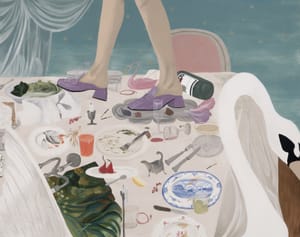
On the occasion of the Milano Art Week and the Milano Design Week, Istituto Svizzero presents the first solo institutional exhibition in Italy by artist Romane de Watteville (1993, Lausanne). The exhibition comes in the form of an environmental installation specifically designed for the spaces of Istituto Svizzero in Milan and titled "I’ll miss you when I scroll away".
De Watteville’s work sways between the pleasure of aesthetic saturation and a vertiginous descent into a digital rabbit hole. Her figurative paintings draw voraciously from a wide range of sources, spanning art-historical iconographies, cinematic motifs and imagery drawn from everyday image-based experiences of fashion and design. Extracted, disassociated and recombined on canvas, her subjects seem to be filtered through the fragmentation of screen-based culture, producing an overloaded, subtly hallucinatory perceptual field.
De Watteville’s exhibition at Istituto Svizzero comprises an installation of disproportionately long folding screens which create a maze of walls across the space. Painted on both sides, these modular structures echo the narrative logic of online scrolling while also calling pre-digital, sequential forms of storytelling into play.
The folding paintings appear to capture the aftermath of a party, the numb time that follows a collective celebration. The scene is dominated by the afterlife of a banquet – the remnants of a lavish dinner disorderly scattered, and now trampled by the heels of anonymous protagonists and visited by grotesque figures, signaling that the festivity has come to an end. The opulence of the remains is meticulously rendered by the artist, whose visual vocabulary combines a certain late-Baroque mannerism with a distinctly cinematic compositional sensibility.
The “post-party” scenario evokes a sense of excess that drifts into entropy, on the edge between prosperity and self-indulgence, celebration and collapse. The pile of discarded objects, images and memories unexpectedly gains agency, revealing the emotional residues that stay in the things we get rid of. What emerges is a form of instant nostalgia: a sense of loss shaped by the ruthless temporality of consumption, where we keep scrolling past images and affections we shall never encounter again.