Monica De Cardenas is pleased to announce “tempo crudo”, a new solo exhibition by Claudia Losi at the gallery in Milano. The exhibition presents a series of new works born from projects of the last five years, which form an ecosystem inviting us to reflect on what “tempo crudo” (“raw time”) represents for each of us. This expression was received by the artist from Judy Jacanamejoy Chicunque, a Colombian anthropologist, poet, and activist (from Sibundoy Valley, Kamëntsa people), during a residency at Fondazione Pianpicollo Selvatico in Piedmont. In Judy's community (and beyond), “tiempo crudo” refers to that precise moment when all beings – living and non-living – resonate in the same chord: they are aligned with each other in a time of grace.
Since the late 1990s, Claudia Losi has focused on a series of projects based on participation and relationship: collective acts that build around individual objects, actions, and texts functioning as catalysts of energies, experiences and shared memories, which Losi reinterprets and redesigns. This is seen in the development of Oltre il giardino (Beyond the Garden): an imposing nearly 18-meter-long jacquard weaving featuring hundreds of images and texts collected through workshops and public calls. Started in 2020, it is the final outcome of the project Being There. Oltre il giardino, produced and exhibited with the support of the Italian Council.
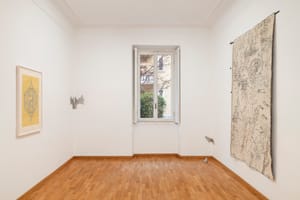
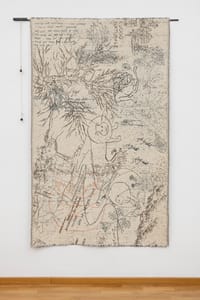
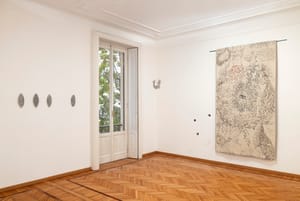
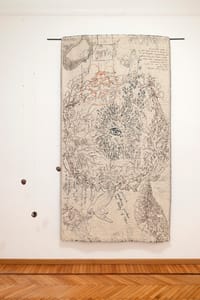
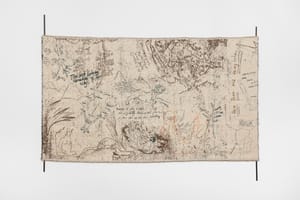
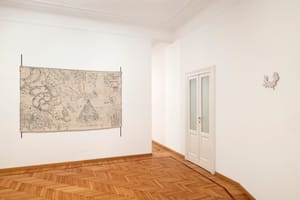
The core of the multifaceted cycle of works scattered throughout the exhibition path in Milano originates precisely from this choral narrative of images in Oltre il giardino. The exhibition opens with Come giardino foresta (Like a Forest Garden): a series of six tapestries of various sizes. Their intertwined images are the responses of over four hundred people to the question "What is your idea of a natural place?". Each tapestry features also embroidered human figures – two connected bodies, in different postures of listening, singing, or conversating. Sporadically, reflective threads are woven into the fabric's weft and warp, that “light up” only when hit by light at specific angles.
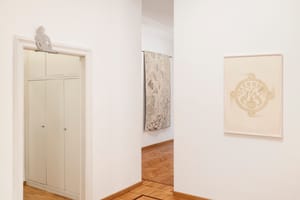
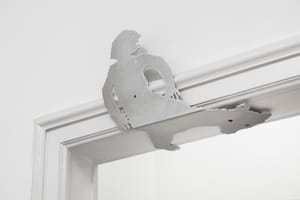
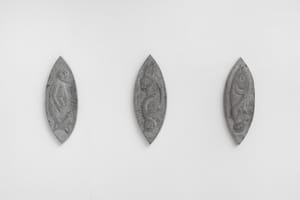
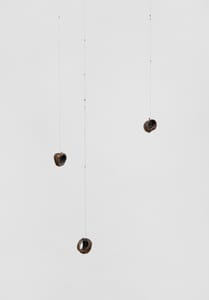
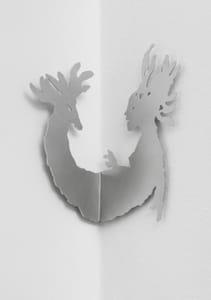
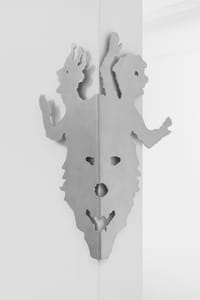
Drawing inspiration from the practice of forest gardening – a farming technique inspired by the structure and principles of a natural forest ecosystem – and its metaphorical interpretation, Losi thinks of these works as part of a young woodland. Thus, just above some tapestries, we find the small bronze sculptures titled Pomi (Pomes), like suspended fruit waiting to be picked: apples hollowed out by hornets, their skin and inside transformed into metal; they are precious and secret presences that allude to both loom weights and hiding places. On the walls there are a series of sculptures, Pietre da filo (Whetstones): inspired by “coti”, ancient tools once commonly used by farmers to sharpen blades: these stones are arranged like amulets marking a hypothetical path. Furthermore, Le anime sottili (The Subtle Souls) are placed in some corners of the gallery rooms. These thin metamorphic metal figures inhabit the margins of spaces: according to the artist, it is precisely in thresholds and boundaries that transformations arise.
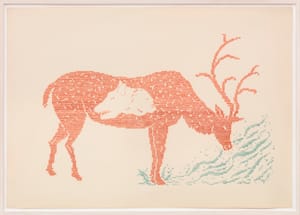
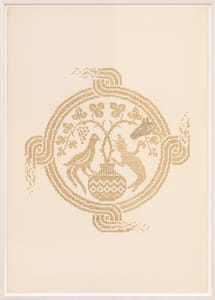
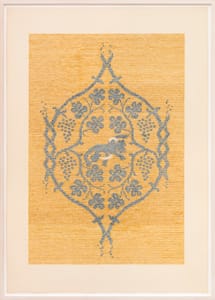
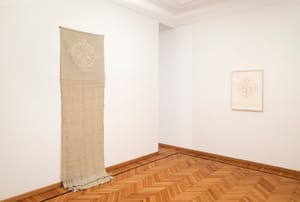
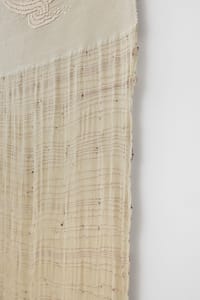
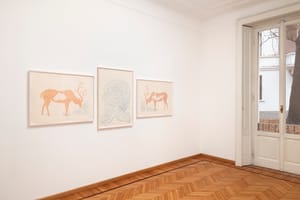
The exhibition ends – or perhaps begins anew – with Variazione #2 (Variations #2): a tapestry woven in Salento fringe technique that extends into a long warp tail with small lead weights. Created by the weavers of Fondazione Le Costantine in Salento, the work intertwines knowledge and gestures passed down through generations, where images introduced by the artist are grafted into their traditional patterns. Linked to these, the pastel drawings Disegni di rimettaggio (Threading Drawings) evoke the grammar of weaving, the memory of the gestures before the gestures as well as an idea transforming into a drawn pattern.
Collectively, all the works on display compose an ecosystem: stories gathered and reintroduced into circulation, recurring gestures, forms calling each other from a distance.
Claudia Losi was born in 1971 in Piacenza, where she lives and works. Among her recent solo exhibitions and performances are La Strozzina/Lo Schermo dell’arte, Florence, 2025; Palazzo Te, Mantua, 2024; Obrera Centro e ICC, Mexico City; permanent installations at Città Studi, Biella, and on the Nembro-Lonno (Bergamo) stretch of the Via delle Sorelle, 2023; Arte in Fabbrica, Collezione Gori, Calenzano; Rocca Roveresca, Senigallia, 2022; MAMbo, Bologna, 2020; Ikon Gallery, Birmingham, 2019; and Collezione Maramotti, Reggio Emilia, 2016. She has also exhibited at MAXXI Museum, Rome; the Royal Academy, London; Marino Marini Museum, Florence; and Stenersen Museum, Oslo; Sharjah Biennial 8, United Arab Emirates, 2007. From 2004 to 2011, she developed the Balena Project: the mythical tale of a life-sized cloth whale that traveled the world, engaging people and imaginations wherever it went. Its story is told in the book The Whale Theory, Un Immaginario animale, Johann & Levi Editore, Monza 2021. The project Being There. Oltre il giardino is among the winners of the Italian Council – 9th Edition, 2020, supported by the MIC, and in 2022, a publication was released by Viaindustriae, Foligno, along with Tra le infinite combinazioni possibili, Gli Ori, Pistoia. In 2021, she published Voce a vento, Kunstverein Milano.
The exhibition features a text by Leonardo Regano